Divorce mediation in Georgia typically resolves contested issues in one to three sessions over 30 to 90 days. A contested divorce that goes to trial takes 6 to 12 months across Fulton, Gwinnett, and Forsyth Counties and costs significantly more in attorney time. But here is what most comparison guides leave out: in those three counties, mediation is not optional. Courts require parties in contested divorces to attempt mediation before scheduling a trial.
The real question is not whether to mediate. It is how to make mediation work so you do not end up paying for both mediation and a trial.
Below is a complete framework for how mediation and court compare in Georgia, when each path makes sense, and how to prepare for mediation so it actually resolves your case.
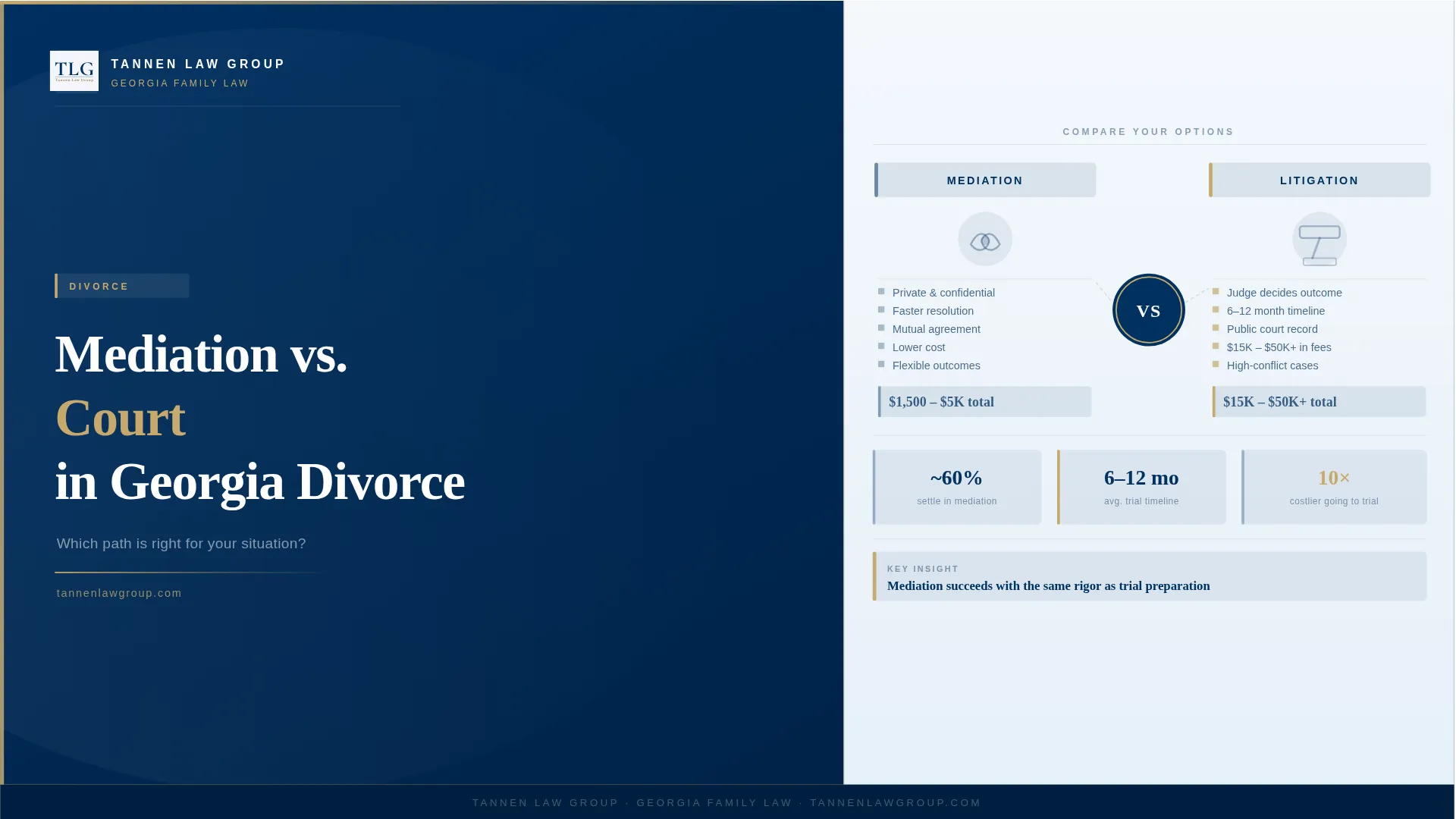
Mediation vs Court Quick Comparison
- Mediation timeline: 1 to 3 sessions over 30 to 90 days.
- Trial timeline: 6 to 12 months across Fulton, Gwinnett, and Forsyth Counties.
- Georgia requirement: Courts in Fulton, Gwinnett, and Forsyth Counties generally require mediation before scheduling a contested trial.
- Control: In mediation, you and your spouse decide the terms. At trial, the judge decides. Judges are not bound by either party’s proposal.
- Confidentiality: Mediation discussions are confidential and cannot be used in court. Trial proceedings are public record.
- Outcome certainty: Mediation produces certainty if you reach agreement; you know the exact terms. Trial introduces judicial discretion and outcome uncertainty.
- Settlement rate: Most contested cases settle before trial. Many settle at mediation.
What Is Divorce Mediation in Georgia?
Mediation is a structured negotiation process where a neutral third party (the mediator) helps divorcing spouses reach agreement on contested issues including property division, spousal support, child custody, child support, and parenting time. The mediator does not make decisions or issue rulings. The mediator facilitates discussion, identifies areas of agreement, and helps the parties work through disagreements.
Each spouse typically has their own attorney present at mediation. The mediator may meet with both parties together (joint session) or shuttle between separate rooms (caucus style). Caucus-style mediation is more common in Georgia family law cases, particularly when emotions are high or communication has broken down.
If mediation produces an agreement, the terms are drafted into a settlement agreement that both parties sign. The agreement is then submitted to the court for approval. Once approved, it becomes a binding court order.
If mediation does not produce agreement on all issues, the unresolved issues proceed to trial. Partial agreements are common: spouses may agree on property division but disagree on custody, in which case only the custody issue goes before the judge.
Georgia Courts Generally Require Mediation Before Trial
This is the fact that changes the entire mediation-vs-court discussion. In Fulton, Gwinnett, and Forsyth County courts, judges routinely order mediation before they will schedule a final hearing or trial in contested divorce and custody cases. Local court rules in the North Atlanta metro area make mediation a standard step in the process.
This means you will likely go through mediation regardless of whether you want to. The strategic question is not “should I try mediation?” It is “how do I prepare for mediation so it actually resolves my case and I avoid the expense and uncertainty of trial?”
Treating mediation as a box to check is the most expensive mistake you can make. Parties who walk into mediation without a prepared proposal, without understanding their own financial position, and without realistic expectations waste the session and still end up at trial. Parties who prepare thoroughly with financial analyses, parenting plan proposals, and a clear understanding of what they will and will not accept settle at significantly higher rates.
When Mediation Is the Right Path
Mediation works well when both spouses are motivated to settle, when the issues in dispute can be resolved through negotiation rather than judicial determination, and when both parties have an accurate understanding of the financial picture.
Common scenarios where mediation produces strong outcomes:
Both spouses want to settle. If both parties are tired of the conflict and ready to move on, mediation gives them the structure to reach agreement without the additional time and expense of trial.
The issues are negotiable. Property division, parenting time schedules, support amounts within a reasonable range, and timing of asset transfers are all negotiable issues that respond well to mediation.
The financial picture is clear. When both parties have complete financial information and reasonable expectations about value, mediation can work through asset division efficiently.
Custody disputes are about schedule, not fitness. When both parents are fit and the dispute is about schedule, mediation can craft a parenting plan that works better than a court-imposed schedule.
Privacy matters. Mediation discussions are confidential. Trial proceedings are public record. For families with privacy concerns (business reputation, social standing, sensitive personal issues), mediation protects information that would otherwise become part of the court record.
When Court Is the Right Path
Mediation requires good faith from both parties. When good faith is absent, mediation cannot work, and trial becomes the necessary path.
Common scenarios where trial is appropriate:
Hidden assets or financial misconduct. If one spouse is suspected of hiding income, transferring assets, or otherwise concealing the marital estate, discovery and trial may be necessary to surface the truth. Mediation cannot work without accurate financial information.
Family violence or safety concerns. When there is a history of family violence or active safety concerns, mediation may not be appropriate. The dynamic of sitting across from an abusive spouse can compromise the victim’s ability to negotiate effectively. A Temporary Protective Order may also be necessary.
Custody disputes involving fitness. When one parent has substance abuse issues, has committed family violence, or otherwise poses a risk to the children, mediation about parenting time is inappropriate. The court needs to make a custody determination based on the best interests of the child.
Bad faith negotiation. When one party uses mediation as a delay tactic, refuses to provide financial information, or makes unreasonable demands designed to fail, mediation cannot produce agreement. The case needs to move toward trial.
Legal issues requiring judicial determination. Some questions cannot be negotiated. Whether a business is marital or separate property, whether a prenuptial agreement is enforceable, whether alimony should be modifiable. These may require a judge’s ruling.
How to Prepare for Mediation
Preparation determines outcome. Parties who arrive prepared settle. Parties who arrive unprepared either fail to settle or accept unfavorable terms.
Complete your financial disclosure. Tax returns, bank statements, retirement accounts, business records, real estate appraisals, debt documentation. Both parties need to be working from the same financial information.
Develop a settlement proposal in advance. Know what you want and what you can accept. Identify the issues where you have flexibility and the issues that are non-negotiable. A vague “we will see what they propose” approach produces poor outcomes.
Understand the alternative. What would a judge likely do if your case went to trial? An attorney who has practiced in your county knows the typical ranges for custody, support, and property division. Knowing the trial outcome range tells you whether a mediated proposal is reasonable.
Bring documentation. If you are claiming an asset is separate property, bring the documentation. If you are claiming the other spouse hid income, bring the records that support it. Mediation is not the time to make unsupported assertions.
Bring your attorney. Mediation works best when each party has their own attorney present. The attorney protects your interests, identifies issues you may not see, and ensures any agreement is enforceable.
The Hybrid Path: Partial Settlement
The most common outcome in Georgia contested divorces is not “settled at mediation” or “tried in court.” It is partial settlement at mediation, with limited issues proceeding to a focused hearing.
Parties may agree on property division but disagree on custody. Or agree on most custody terms but disagree on holiday allocation. Or agree on child support but disagree on alimony. When this happens, the settlement agreement covers the resolved issues, and the trial focuses on the limited unresolved issues.
This hybrid approach captures most of the cost and time savings of mediation while still producing a definitive ruling on the issues that cannot be negotiated.
Frequently Asked Questions
Is mediation mandatory in Georgia divorce?
In Fulton, Gwinnett, and Forsyth Counties, courts generally require mediation before scheduling a contested trial. The court may waive the mediation requirement in specific circumstances (family violence, urgent custody issues, etc.), but mediation is the default expectation.
Can mediation work if my spouse and I are not speaking?
Yes. Caucus-style mediation, where the mediator shuttles between separate rooms, is specifically designed for cases where direct communication has broken down. You do not need to be in the same room as your spouse.
What if my spouse will not negotiate fairly at mediation?
Mediation requires good faith from both parties. If your spouse refuses to engage seriously, the mediator will document the impasse, and the unresolved issues proceed to trial. Mediation is not a trap that locks you into unfavorable terms; either party can decline to settle if the proposed terms are not acceptable.
Are mediation discussions confidential?
Yes. Mediation discussions are confidential under Georgia law and cannot be used as evidence in court if the case proceeds to trial. This confidentiality allows parties to explore settlement options without committing themselves.
What happens if we reach agreement at mediation?
The terms are drafted into a settlement agreement that both parties sign. The agreement is submitted to the court for approval. Once approved, it becomes a binding court order, enforceable as any other court order.
How long does mediation take?
Most mediations are 1 to 3 sessions over 30 to 90 days. Simple cases may resolve in a single session. Complex cases with significant assets or contested custody may require multiple sessions.
Can I still go to trial if mediation fails?
Yes. If mediation does not produce agreement on all issues, the unresolved issues proceed to trial. Mediation does not bind you to a particular outcome.
Get an Honest Assessment of Your Path
Whether mediation is the right path for your case depends on the specific issues in dispute, your spouse’s willingness to negotiate, and whether good faith is present. We assess this in every free consultation.
Call or text (470) 560-7798
Tannen Law Group | 6455 East Johns Crossing, Suite 425 | Johns Creek, Georgia 30097
Your Free Consultation Includes:
- A realistic assessment of whether your case is suited to mediation.
- A timeline estimate for both mediation and trial paths.
- Strategy for preparing for mediation if that is the right approach.
Schedule your free 30-minute consultation online
No obligation. No spam. We respond within 2 hours during business hours.
Not ready to call? Read: Settlement Agreements in Georgia | Contested Divorce in Georgia
Related Resources
Deciding between mediation and litigation is easier with the full process in view. Start with our Georgia divorce process guide, and if you are evaluating representation, our guide to the best divorce lawyers in Johns Creek covers the questions worth asking.